Curtains
Designer Curtain Fabric in South Africa: What Home Fabrics Actually Carries
Galaxy Blinds

There is a persistent belief that the good European fabric houses are not available in South Africa, or that getting hold of them means a container and a three month wait. They are available, and they have been for years. Home Fabrics describes itself as South Africa’s premier distributor of fabrics and wallpapers, working out of a head office in Port Elizabeth with showrooms in eight cities, and the books it carries include names that interior magazines treat as aspirational. The useful question is not whether you can get them. It is which one belongs in your room, and which of the two performance labels you should be asking for.
Key takeaways
- Nina Campbell, Osborne & Little, JAB, Carlucci, Chivasso, Arte and AS Creation are all distributed here.
- The international houses are decorative. The local brands are where the performance fabrics sit.
- FibreGuard comes in three versions, standard, Pro and Outdoor, and they are not interchangeable.
- FR-One is the flame retardant label, and it is what decides whether fabric is allowed in a commercial building.
- Fabric Library is the foundation range, and Fabric Library Wide is the one that saves you a seam on a wide window.
- Home Fabrics supplies the trade, so you buy through a decorator or a curtain maker.
The international houses, and where each one belongs
These are the decorative collections, and the differences between them are real rather than marketing. Picking by mood instead of by name gets you a better result.
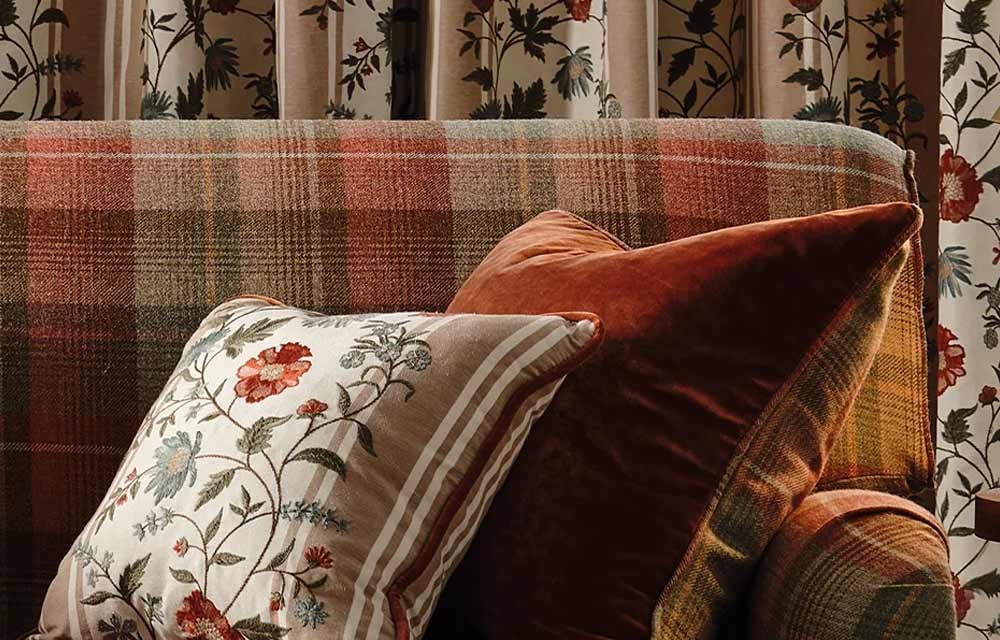
Nina Campbell is classic British elegance, which in practice means it sits comfortably in a room with existing furniture, inherited pieces and a bit of pattern already in play. It is the safest choice in a formal lounge or a main bedroom in an older house.
Osborne & Little is the decorative design house, sophisticated fabrics and strong pattern. It wants to be the loudest thing in the room, so give it plain walls and restrained furniture or it will fight everything.
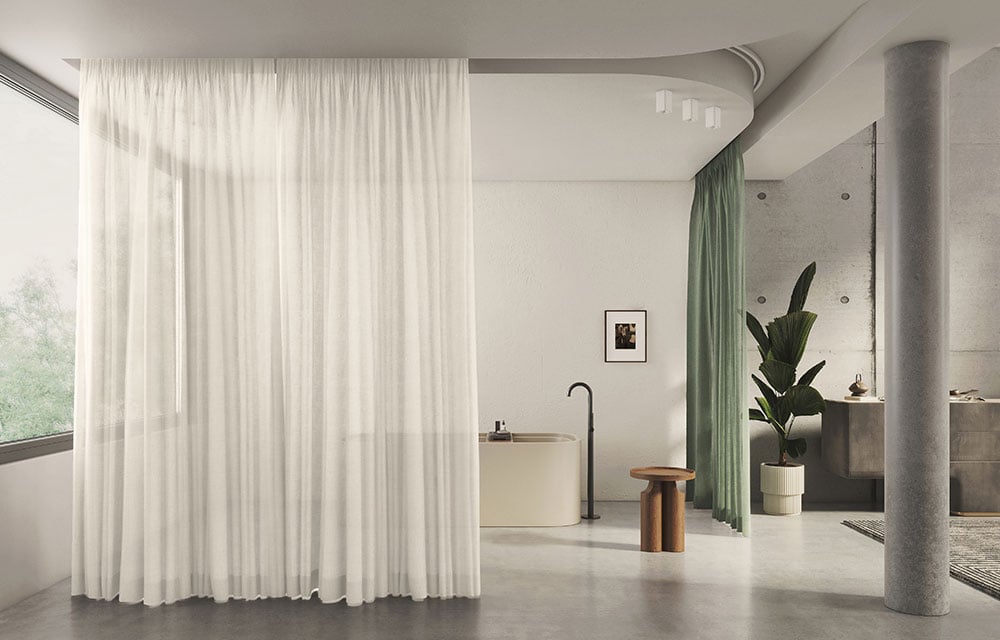
JAB reads as distinctly modern European: cleaner, more architectural, less pattern. This is the one for a new build or a renovated flat with large openings and hard finishes, where a floral would look pasted on.
Carlucci, a JAB brand, is bold, glamorous and expressive, with rich textures and modern pattern. It is the right answer when a client says they want drama and means it.
Chivasso, also a JAB brand, is contemporary and trend driven, playful but still sophisticated. It suits a space with a bit of personality, a media room, a teenager’s room done properly, a holiday house.
Arte and AS Creation are the wallcovering houses, Arte at the high end and AS Creation at the accessible end. Worth knowing about because a wallpaper and a curtain fabric chosen from the same supplier are far easier to coordinate than two chosen from different ones. Sansaar is a newer collection built around sustainability. You can see the full list on the Home Fabrics brands page.
The performance labels nobody thinks to ask for
This is the part that saves money, and almost nobody raises it until something has already been ruined.
FibreGuard, in three versions
Home Fabrics lists FibreGuard, FibreGuard Pro and FibreGuard Outdoor on its local brands page, and the distinction matters. Standard FibreGuard is the stain free label for domestic interiors, built to release everyday household stains. Pro sits above it for heavier use. Outdoor is built for exposure, which is a different problem entirely, because outdoors the enemy is ultraviolet and damp rather than ketchup.
The mistake we see is standard FibreGuard specified for a covered patio because the word stain free sounded like it covered everything. It does not cover sunlight. If the fabric is going anywhere it catches direct sun, the question is light fastness, not stain release. Our guide to outdoor blinds in South Africa covers the same principle on the blind side.
FR-One, and why it is not optional
FR-One is described as a recognisable quality label and a guaranteed flame retardant solution meeting applicable standards. In a house, nobody will ever ask you about it. In a guest house, a restaurant, an office, a school or a retirement village, it is frequently the thing that decides whether the fabric is permitted at all, and finding that out after the curtains are made is an expensive lesson.
Two honest cautions. First, we do not quote a South African fire standard number here, because the requirement depends on the building, its classification and sometimes the insurer, and a wrong standard number in writing is a liability rather than a technicality. Ask your architect, your fire consultant or your insurer what the building requires, then specify to that. Second, flame retardant performance can be inherent to the fibre or applied as a treatment, and treatments can be affected by washing. Ask which one you are buying and what the care instruction is. You can read the label’s own material at fr-one.com.
If you are specifying for an office or a commercial fitout, our corporate blinds and curtains page covers how we handle those jobs.
Fabric Library, and the seam you can avoid
Fabric Library is the foundation collection, spanning curtaining, sheers and upholstery at competitive prices. It is not glamorous and it is genuinely useful, because most houses need six windows done sensibly and one done beautifully.
Fabric Library Wide is the one worth knowing by name. Standard curtain fabric is woven to a width that has to be railroaded or joined on a wide window, which means a visible seam running down a panel. Wide width cloth lets a wide window or a tall sheer be made in one piece. On a sliding door or a stairwell sheer, that single detail is the difference between a professional result and one where your eye goes straight to the join. Always ask whether a wide width option exists before accepting a seam.
Choosing by room
| Room or project | Where to look | What decides it |
|---|---|---|
| Formal lounge, main bedroom, older home | Nina Campbell | Classic pattern that sits with existing furniture |
| Statement room with plain walls | Osborne & Little, or Carlucci for drama | Strong decorative pattern needs space around it |
| New build, apartment, large glazing | JAB | Modern European, architectural rather than floral |
| Media room, holiday house, children’s room | Chivasso | Contemporary and playful without being childish |
| Dining room, family lounge, pets | FibreGuard or FibreGuard Pro | Stain release, applied across a wide fabric selection |
| Covered patio or anywhere in direct sun | FibreGuard Outdoor | Ultraviolet and damp, not household stains |
| Office, guest house, restaurant, school | FR-One | Flame retardancy, as required by the building |
| Wide windows, sliding doors, stairwell sheers | Fabric Library Wide | One piece instead of a seam down the panel |
| Whole house on a sensible budget | Fabric Library | Curtaining, sheers and upholstery at one price point |
How you actually get it
Home Fabrics distributes to the trade. The showrooms in Johannesburg, Pretoria, Cape Town, Durban, Port Elizabeth, George and Bloemfontein exist so that fabric can be seen properly, but the buying happens through a decorator or a curtain maker. That is not an obstacle, it is how fabric should be bought, because the person measuring your window should also be the person choosing the weight.
Which is where we come in. We work from the Home Fabrics books along with other houses, and we specify to the room rather than to the photograph. If you want to see designer cloth against your own light and your own walls, request a quote and we will bring samples to you. If you are still deciding between soft and hard window coverings, blinds or curtains works through that first.
Frequently asked questions
Can I buy designer fabric like Osborne & Little directly in South Africa?
Not directly. Home Fabrics distributes to the trade, so you buy through a decorator or a curtain maker. The showrooms exist so the fabric can be seen, but the order is placed by the trade account.
What is the difference between FibreGuard and FibreGuard Outdoor?
Standard FibreGuard is a stain free label for domestic interiors, built to release everyday household stains. Outdoor is built for exposure, where the problem is ultraviolet and damp rather than spills. Specifying standard FibreGuard for a sunny patio is a common and expensive mistake.
Do I need FR-One fabric in my house?
Almost certainly not. FR-One matters in commercial and public buildings, guest houses, restaurants, offices, schools and retirement villages, where flame retardancy is frequently what decides whether a fabric is permitted at all. Ask your architect, fire consultant or insurer what your building requires.
What is wide width curtain fabric and why does it matter?
Standard curtain fabric is woven to a width that has to be joined on a wide window, which leaves a visible seam down the panel. Wide width cloth, such as Fabric Library Wide, lets a wide window or a tall sheer be made in one piece. On a sliding door or a stairwell it is the difference between a clean result and one where your eye goes to the join.
Is designer fabric worth it on every window?
No, and we would not specify it that way. Most houses need several windows done sensibly and one done beautifully. Foundation ranges cover the first, the decorative houses cover the second, and spending evenly across every window usually produces a result that is expensive without looking it.
See the fabric in your own light
Fabric lies in a showroom and tells the truth in your window. North facing light flattens pattern, south facing light cools colour, and a sample that looked warm on a Kramerville counter can read grey in a Johannesburg lounge. We bring the books to you, we measure before we quote, and we will tell you when a cloth you love is wrong for the room. Start with our curtains page, or request a quote.